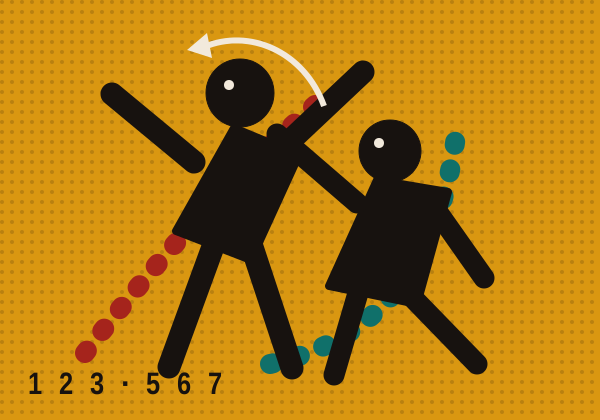
Six styles, two axes of distinction, and a basic step shared by them all: quick, quick, slow.
The foundation
Structure is not timing
This is the most common misconception surrounding salsa styles, and it muddles every discussion. Structure and timing are two entirely independent axes. Every style has both.
Axis 1 — Structure
Line or circle
How does the couple travel across the dance floor? Either back and forth along an imaginary track (linear, “in the slot”) or around one another (circular, rotating).
Black: leader. Green: follower.
Axis 2 — Timing
On which count?
An eight-count phrase always follows the same pattern: three weight changes, a pause, three weight changes, a pause. The question is where within those eight counts the break step falls, the step that reverses direction.
On1 — break on count one
12345678
On2 — break on the two
12345678
The dashed fields, counts 4 and 8, are pauses with no weight transfer. This produces the familiar “quick, quick, slow” rhythm.
The point
Every style combines both axes. LA style = linear + On1. New York = linear + On2. Casino = circular, today mostly danced On1. The claim that “On2 is the advanced style” is therefore mistaken: On2 is a different rhythmic reference point, not a higher level.
The common foundation
The basic step
The same mechanics apply across all styles: six weight transfers occur within an eight-count phrase, distributed across three positions: forward, center, and back. The dancer holds their weight for two counts.
The diagram on the right shows the leader's basic step in LA-Style On1. The break step falls on count one: the left foot steps forward and reverses the direction of travel. On count five, the same action occurs backward.
The follower dances the mirror image: where the leader steps forward, the follower steps back.
A note on footwork
Teaching traditions do not always assign the same foot to the same count, especially in On2. Eddie Torres New York On2 and the older Palladium or Son-On2 traditions break in opposite directions on count two. The reliable distinction is the count on which the break step falls, not which foot executes it.
LA-Style On1, leader's steps
12345678
Red = forward break step · Green = back break step · Black = weight transfer in place.
The collection
Six styles
Cuban Style / Casino
Circular · mostly On1 · Cuba
The original style. Partners travel around one another rather than along a line, giving Casino a more compact, social quality than linear styles. Its name derives from the Cuban dance halls of the 1950s, the Casinos Deportivos.
Its characteristic body movement comes from Afro-Cuban traditions: pronounced hip and shoulder movement, with occasional free-form passages of despelote. Casino is danced not only to salsa, but also to Son, Mambo, and modern timba.
Timing
today mostly On1; historically also contratiempo and On3
Feature
Rotation, body isolations, playful
Music
Son, Casino, Timba
Rueda de Casino
Circle formation · Cuba, 1950s
Casino danced in a circle: several couples form a rueda, while one caller (el cantante) names the figures for everyone to perform in unison. At the call «Dame», everyone changes partners. It is equal parts dance and communal game.
Core vocabulary: guapea (basic step), dile que no (the return figure that concludes many combinations), enchufla (“plug in”), sombrero, setenta (“70”), vacílala, exhíbela, coca-cola, adiós.
Principle
Called figures rather than conventional partner leading
Record
1,585 people, Caracas, November 27, 2022, for almost 12 uninterrupted minutes
Previous record
1,102 people, Thessaloniki, June 1, 2014
LA style — Salsa On1
Linear · On1 · Los Angeles, 1990s
The world's most widely taught style, and most dancers' point of entry. The couple moves along a line, with the break step on count one, the easiest beat to locate in the music. This makes the style particularly accessible to beginners.
Developed and popularized by the Vazquez brothers, it incorporates elements of tap dance and stage performance: rapid multiple turns, dips, and lifts. The style is designed for visual impact and works as readily on stage as on the social dance floor.
Timing
Breaks on 1 and 5
Features
Fast, show-oriented, with numerous turns
Origin
Los Angeles
New York Style — Salsa On2
Linear · On2 · New York
Also known as “Mambo.” The break step falls on count two, and not by chance: this is where the conga slap falls within the tumbao. The dance thus takes its cue more directly from the percussion than from the melody, lending it a poised, elongated quality.
Eddie Torres codified the style, developing the first systematic teaching method for it from the 1970s onward. Hallmarks include close attention to body isolations, elegant arm styling, and extended shines, solo passages in which the partners separate.
Timing
Breaks on 2 and 6
Character
Flowing, musical, with an emphasis on shines
Reference
The conga slap on count two
Cali style — Salsa caleña
Circular · Colombia
The fastest style in the world. Cali dancers cover very little ground; instead, everything happens in the feet: tiny, exceptionally rapid steps alternating between heel and ball, at a pace that often appears double-speed on video. The upper body remains comparatively still.
Rooted in 1960s Pachanga and Boogaloo influences, the style has a strong performance and competitive tradition, including acrobatics and lifts. Cali calls itself the “world capital of salsa,” a claim supported by the extraordinary density of its dance schools.
Feature
highest step frequency, little space travel
Origin
Cali, Colombia
Context
Competition and show dance
Puerto Rican style
Linear · On1, On2 or On3
The most difficult style to define, because it is shaped less by a fixed timing than by an approach: musical phrasing, space for one's partner, and an appreciation of footwork. It is danced on different counts and is often described as “On2 contratiempo,” that is, against the downbeat.
Followers characteristically receive considerably more room for individual expression than in more choreographed styles. The dance is a conversation, not a performance.
Timing
Variable: On1, On2, On3
Features
Footwork, phrasing, freedom
Related
Miami-Style Casino as a distinct variation
At a glance
Comparison
Six styles according to structure, timing and character
Style
Structure
Break step
Character
Origin
Casino
circular
mostly 1
social, body-led
Cuba
Rueda de Casino
circle formation
mostly 1
called figures, partner changes
Cuba
LA style
linear
1
fast, showy
Los Angeles
New York
linear
2
flowing, percussion-led
New York
Cali
circular
variable
frenetic footwork
Colombia
Puerto Rico
linear
1, 2 or 3
phrasing, individual expression
Puerto Rico
Beyond salsa
Related dances
At congresses and dance schools, salsa is almost never taught in isolation. These dances belong to the same cultural and social world:
Cha-cha-chá
Cuban, created by Enrique Jorrín in the early 1950s. Slower than salsa, with the characteristic triple step on “cha-cha-chá”.
Son
The ancestor: considerably slower and more upright, with a pronounced contratiempo timing, the source of what is now called contratiempo or On2.
Pachanga
A Cuban dance popular in 1960s New York. Buoyant, with a characteristic up-and-down motion, it survives today chiefly as a vocabulary of steps within salsa.
Listening tip: “La Pachanga Se Baila Así” by Charlie Palmieri. The Charanga line-up supplies the characteristic violins and woodwind timbre; the instrument heard here is a flute, not a clarinet. Search on Spotify · Search on Apple Music
Boogaloo
New York, 1960s: Latin soul, the brief fusion of Afro-Cuban rhythms with African-American rhythm and blues.
Bachata
Dominican. Guitars, bongó, and güira articulate the four-beat measure; the hip accent and tap fall on count four. Originally rural guitar music, bachata is now the second mainstay of salsa parties worldwide.
Merengue
Dominican. A fast duple meter, driving tambora, and the güira's steady scrape propel its simple marching step and exuberant party character.